 Wäicuni Foundation
Native American Programs
Sovereignty · Health Independence · Lifeways · Economic Development
In Arizona, four thousandths of one percent of small business lending reaches borrowers on reservations. In New Mexico, twelve thousandths.
The numbers differ by state. The barrier does not. It holds across all 575 federally recognized nations, from the Alaska Native villages that make up two-fifths of them to the pueblos of the Southwest, and not because the businesses do not exist. Because the system was built to lend against land that cannot be mortgaged.
Land held in trust cannot be pledged as security. For most American families the house is the collateral that makes a business loan possible; in Indian Country that instrument does not exist. This is not a credit problem. It is a structural exclusion, written into how the land is held.
The second barrier comes earlier and is almost never funded. Before any lender is involved, a franchisor or other startup business requires a minimum amount of liquid capital, commonly $50,000 to $200,000, and explicitly not counting home equity. An applicant who cannot show it is declined at the first conversation, with a viable business plan and nowhere to take it.
Some applicants can qualify for a federal loan and simply cannot produce the owner's contribution it requires. Federal programs will finance 80 to 90 percent of a qualified franchise; what they will not supply is the down payment and reserves that make an applicant eligible in the first place. We fund that position outright. A grant of $70,000 against a $350,000 franchise is not a subsidy: it is the equity that turns an applicant a lender had to decline into one it can approve, and it brings four to five dollars of conventional capital with it.
Other applicants have no conventional path at all. Not because the plan is weak, but because the underwriting model was built around collateral they are structurally barred from holding. For those, we fund the business itself, and we ask for the money back only if the business succeeds, so that it can go to the next owner.
Both begin the same way: a completed Certificate of Standing and a plan we have vetted. We do not put money into a deal that was not going to work. We remove the obstacle that was going to stop one that would.
A course in the principles of building a business that lasts. It covers what actually decides outcomes: reading a Franchise Disclosure Document, building and defending a capital stack, the SBA process end to end, separating business from personal credit, and planning working capital through the ramp period.
Completion earns the Certificate of Standing, which every applicant to The Standing Fund must hold before applying.
Standing Ground is open to enrolled citizens of federally recognized tribes, and to tribally recognized descendants residing on tribal land. In both cases the tribe determines who qualifies. We do not.
The course is free to participants and taught in cohorts.
Capital and training for Native business owners: The Standing Fund and Standing Ground.
Government relations, policy analysis, and jurisdictional capacity for nations exercising self-determination.
In developmentTribal healthcare capacity, IHS navigation, and the integration of traditional medicine.
In developmentLanguage, ceremony, arts, and the transfer of knowledge between generations.
In development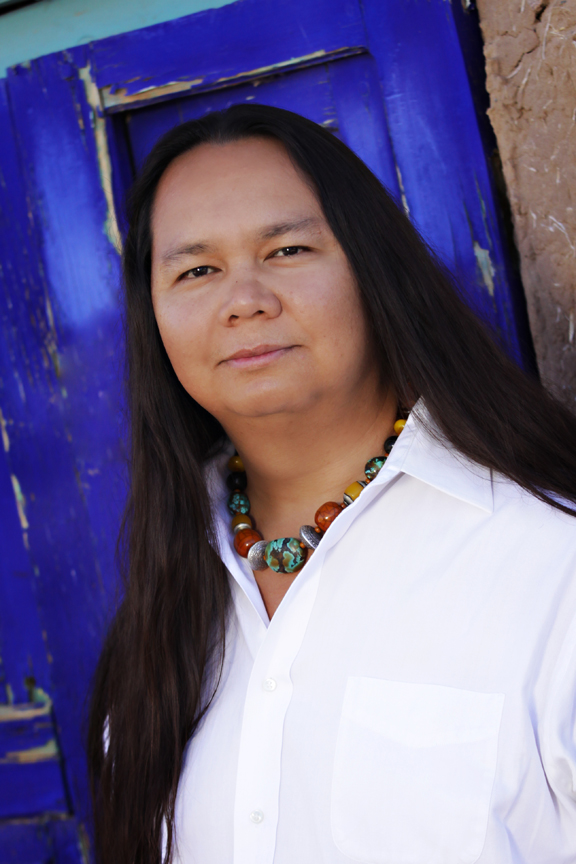
Ken Lingad directs Wäicuni Foundation's Native American Programs.
He was born and raised on an Indian reservation, by a grandfather who remains a respected leader across American Indian Country long after his passing. His understanding of Indian affairs was formed at kitchen tables and in sacred spaces, with Tribal leaders from near and far away, since he was a child.
That grounding is matched by decades inside the institutions that move capital. He served as advisor on Indian Affairs, Policy and Communications to New Mexico Governor Bill Richardson, representing 23 tribes, nations and pueblos across the United States, the United Kingdom and China. He is a Certified Tribal Housing Professional and has consulted several local, nationwide, and global nonprofit organizations. He is a recognized authority on tribal economic development, housing, healthcare, cultural arts, and sovereignty dynamics, and his work is chronicled in Contemporary Native American Artists (Gibbs Smith, 2012).
Few people read a Franchise Disclosure Document and a tribal constitution with equal fluency. That combination is why this program can assemble a capital stack its applicants could not assemble alone, and why the people it serves bring it their plans.
We are raising $300,000 to open the first cohort: curriculum development and delivery for participants, and $375,000 for the first round of awards.
Three owners financed alongside conventional lenders at an average award of $75,000, and one owner financed in full who had no other route, at an average award of $150,000 (returned to The Standing Fund as those businesses reach stability), unlocking roughly $1,200,000 in total business capitalization.
Awards are made against published criteria, recorded, and ratified by our Board above a set threshold. Completion of the certificate is required, as is documented evidence that conventional financing is unavailable. Some awards carry a repayment obligation that arises only if the business reaches defined stability; those terms are stated in writing before any award is accepted. We do not make awards to our own directors, officers, or their businesses, and we hold no relationship with any franchisor.